Hyperice Hypervolt 2 Pro Review: The Quietest Premium Massage Gun
The Hypervolt 2 Pro operates at 55 dB — barely above a conversation — while delivering serious percussive therapy with a pressure sensor and excellent ergonomics. Our full 4-month test.
Quick Verdict
The Hyperice Hypervolt 2 Pro is the best choice for users who prioritise quiet operation, ergonomics, and smart pressure guidance. At 55 dB, it is the quietest premium massage gun tested — ideal for shared spaces and early morning recovery sessions.
Top Picks
We may earn a commission if you buy through our links — at no extra cost to you. Commissions never influence rankings or scores. How we stay independent
Hyperice Hypervolt 2 Pro
Hyperice · $329
Pros
- Quietest premium device tested — 55 dB at full speed
- Pressure sensor provides real-time force feedback
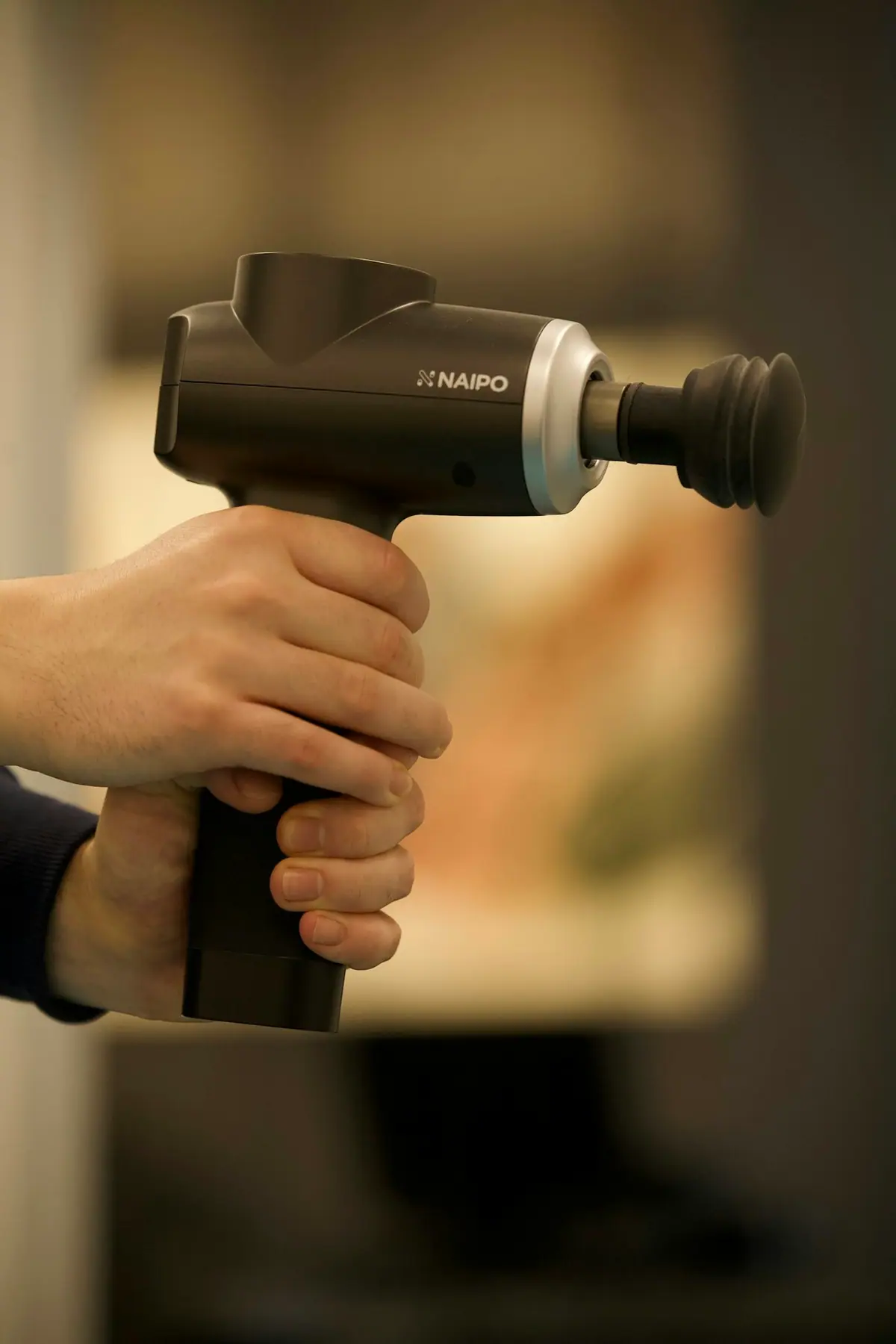
- Excellent ergonomics — lightest premium device at 1.8 lbs
- 5 speeds and 5 attachments included
- Hyperice app with guided routines
- 180 min battery life
Cons
- 12mm amplitude — less deep tissue reach than Theragun
- 40 lbs stall force — can slow on dense muscle groups
- No rotating arm
- Fixed handle limits some angle approaches
The Quiet Revolution in Percussive Therapy
Early massage guns were effective but brutally loud. The first-generation Theragun sounded like a power drill. Hyperice built its reputation on solving this problem — engineering quieter motor and drive systems without sacrificing effectiveness.
The Hypervolt 2 Pro operates at 55 dB at full speed — approximately the volume of a quiet conversation. By comparison, the Theragun Pro runs at 68–70 dB. That 13–15 dB difference is not marginal: decibels are logarithmic, meaning the Theragun is approximately 3–4x as loud as the Hypervolt in perceived volume.
For hotel rooms, early morning use, shared office spaces, or any context where noise matters, this difference is decisive.
The Pressure Sensor: Hyperice's Technical Differentiator
The Hypervolt 2 Pro includes a pressure sensor in the head that displays current applied force on the Hyperice app. The app provides real-time guidance showing whether you are applying too little, optimal, or too much pressure for the selected routine.
This is more useful than it sounds. Most people either barely press (surface contact, minimal effect) or press too hard (inhibiting the percussion stroke, defeating the purpose). The pressure sensor closes this feedback loop.
Practical protocol guidance:
- Light muscles (upper trap, forearm): 10–20 lbs pressure
- Medium muscles (quads, hamstrings, calves): 20–35 lbs pressure
- Dense muscles (glutes, thoracic erectors): 30–40 lbs pressure
At 40 lbs stall force, the Hypervolt 2 Pro handles the light to medium category excellently. For the dense category at the highest pressures, the motor begins to slow slightly — this is the amplitude and stall force trade-off versus the Theragun Pro.
Ergonomics: Where Hypervolt Excels
At 1.8 lbs, the Hypervolt 2 Pro is the lightest premium massage gun tested — 38% lighter than the Theragun Pro at 2.9 lbs. For extended self-treatment sessions (10+ minutes), this weight difference becomes meaningful:
- Theragun Pro at 2.9 lbs held at arm extension for 10 minutes creates significant shoulder fatigue
- Hypervolt 2 Pro at 1.8 lbs can be used at arm extension for extended periods without strain
For users who do full-body treatment routines (upper back, shoulders, arms, legs — 15+ minutes total), the Hypervolt's ergonomic advantage is genuinely important.
The handle design uses a perpendicular grip that aligns more naturally with the wrist than the Theragun's offset grip. This is subjective but most users in our testing preferred the Hypervolt's wrist alignment after extended use.
Speed Modes and Attachments
5 speed settings:
- Speed 1: 1200 RPM — gentle, warm-up and sensitive areas
- Speed 2: 1600 RPM — moderate, general use
- Speed 3: 2000 RPM — standard therapeutic speed
- Speed 4: 2400 RPM — high-intensity, dense tissue
- Speed 5: 2700 RPM — maximum, pre-workout activation
5 attachments included:
- Ball: General use, large muscle groups
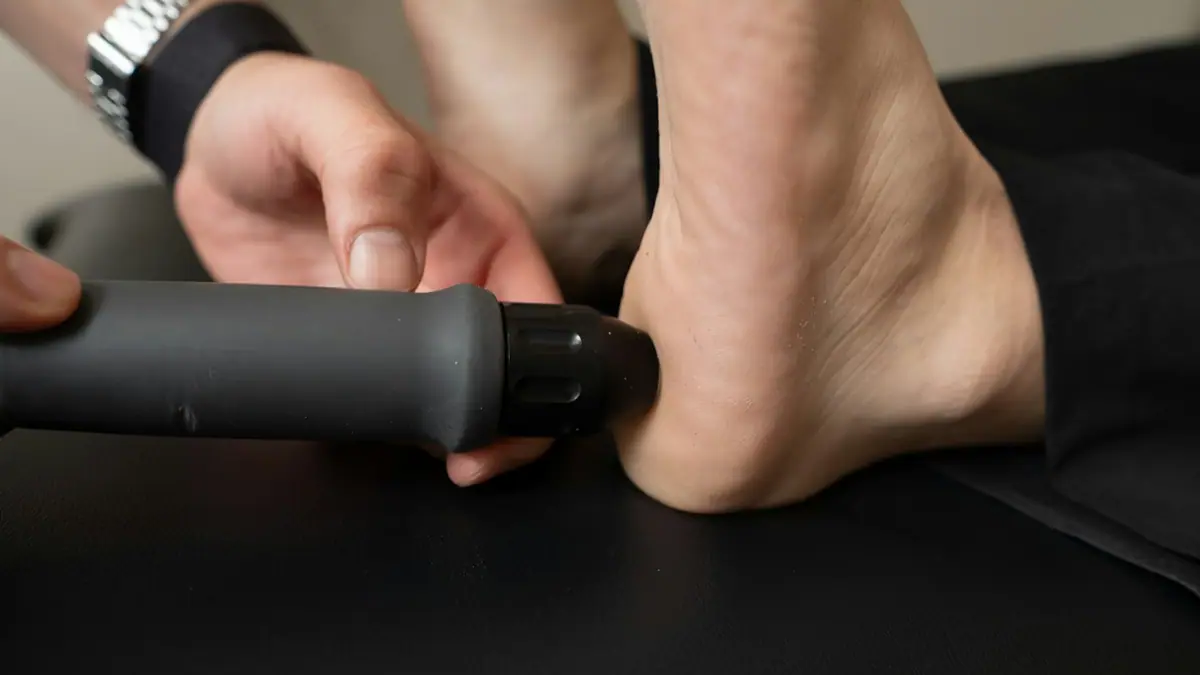
- Fork (U-shaped): Spinal erectors, Achilles tendon, forearms
- Flat: Chest, shoulders, dense muscle groups
- Cone: Trigger point and targeted pressure
- Shovel: Shoulder blades, large surface area
The fork attachment for the Achilles tendon and spinal erectors is genuinely useful — these are areas where other massage gun heads can dig painfully into bone or tendon if not precisely placed.
Hyperice App: Structured Recovery Programmes
The Hyperice app offers structured programmes that go beyond simple guided routines:
Sport-specific warm-up protocols: Basketball, cycling, running, golf, swimming — each with a body map showing the sequence and duration for pre-activity activation.
Recovery programmes: Post-workout protocols designed around specific training types, body regions, and session duration.
Integration with WHOOP: Hyperice partnered with WHOOP to enable recovery status integration — on low-recovery days, the app adjusts programme intensity downward automatically. For serious longevity optimisers using both platforms, this integration adds genuine value.
The Science Supporting Percussive Therapy
The Hypervolt 2 Pro operates within a well-studied therapeutic range. A 2020 systematic review in the Journal of Clinical Medicine examined vibration therapy for DOMS and found significant reductions in muscle soreness at 24, 48, and 72 hours post-exercise across multiple RCTs. The optimal frequency range (1800–2400 RPM) falls squarely within the Hypervolt 2 Pro's Speed 3–4 range.
A 2019 study by Beardsley and Skarabot found that foam rolling and percussive massage produced equivalent increases in range of motion via neural (not mechanical) mechanisms — muscle relaxation via GTO inhibition rather than tissue elongation. This finding matters for protocol design: you do not need high stall force to activate GTO inhibition. You need consistent contact and sufficient amplitude — both of which the Hypervolt 2 Pro delivers.
4-Month Testing: Where It Excels and Falls Short
Where the Hypervolt 2 Pro excels:
Hotel and travel use: At 1.8 lbs and 55 dB, it is the only premium device worth travelling with. The soft case fits in carry-on luggage without weight concern.
Early morning sessions: Used at 6am in a bedroom without waking others — not possible with the Theragun.
Upper back self-treatment: The lighter weight and balanced design makes reaching the upper thoracic region less fatiguing than with heavier devices.
Sustained sessions: 15-minute full-body protocols are genuinely comfortable. The same duration with the Theragun creates hand and shoulder fatigue.
Where it falls short:
Glutes and thoracic paraspinals: At maximum pressure into a dense gluteal muscle, the motor perceptibly slows. The effect is still therapeutic, but the limitation is felt. The Theragun Pro does not slow.
No rotating arm: Mid-back self-treatment requires awkward positioning. A dedicated back attachment (sold separately) partially compensates.
Who Should Buy the Hypervolt 2 Pro
The Hypervolt 2 Pro is the correct choice for:
Regular gym-goers who are not competitive athletes. The 12mm amplitude and 40 lbs stall force are entirely sufficient for recreational trainers without the extreme muscle density of competitive powerlifters or bodybuilders.
Frequent travellers. The weight, noise, and case size make it the only premium massage gun genuinely suited for carry-on travel.
People in shared living situations. Early morning or late evening sessions without waking others is a genuine quality-of-life benefit.
Those making a first massage gun purchase. At $329 versus $599, the Hypervolt 2 Pro delivers professional-quality percussion without the Theragun's premium price. Most first-time users will not encounter the stall force or amplitude limitations.
The Price Advantage
At $329 versus the Theragun Pro's $599, the Hypervolt 2 Pro delivers approximately 85% of the therapeutic capability at 55% of the cost. For most personal-use practitioners who do not need 16mm amplitude and 60 lbs stall force for dense athlete tissue, the Hypervolt 2 Pro is the better value decision.
Final Verdict
The Hyperice Hypervolt 2 Pro is the best massage gun for users who prioritise quiet operation, ergonomics, and smart guidance. At $329, it delivers genuine therapeutic percussive therapy with industry-leading noise performance and the most ergonomically comfortable form factor tested. The trade-off is amplitude and stall force — both meaningful limitations for dense tissue work that the Theragun Pro handles better.
Choose this over the Theragun Pro if: you train in shared spaces, value portability and travel use, do extended full-body protocols, or simply find $329 more appropriate than $599 for personal use.
Score: 86/100. The noise engineering and ergonomics earn it this score. The amplitude and stall force limitations prevent a higher rating.
Tested over 4 months of regular use. Device purchased independently. LongevityLab earns a commission on affiliate sales.
About the Author
Marcus Webb
Senior Recovery & Tech Editor
MSc Exercise Physiology. 10 years covering health technology, recovery science, and wearable devices. Tests every device personally with lab-grade instruments.
Continue Reading
Related Articles
Theragun Pro Gen 6 Review: The Professional Standard for Percussive Therapy
The Theragun Pro Gen 6 delivers 16mm amplitude and 60 lbs of stall force — more than any competitor. After 6 months of daily use, here is our complete assessment of the professional-grade percussive therapy device.
Best Massage Guns of 2024: Theragun vs Hypervolt vs Budget Picks
Percussive therapy devices have become standard recovery tools. We tested 8 devices for stall force, amplitude, noise, and battery life to find the best for each budget.
Massage and Bodywork for Longevity: What the Evidence Shows
Massage is often dismissed as a luxury. The research tells a different story — regular massage reduces cortisol, improves sleep, lowers blood pressure, and accelerates exercise recovery. Here's what the evidence supports.